

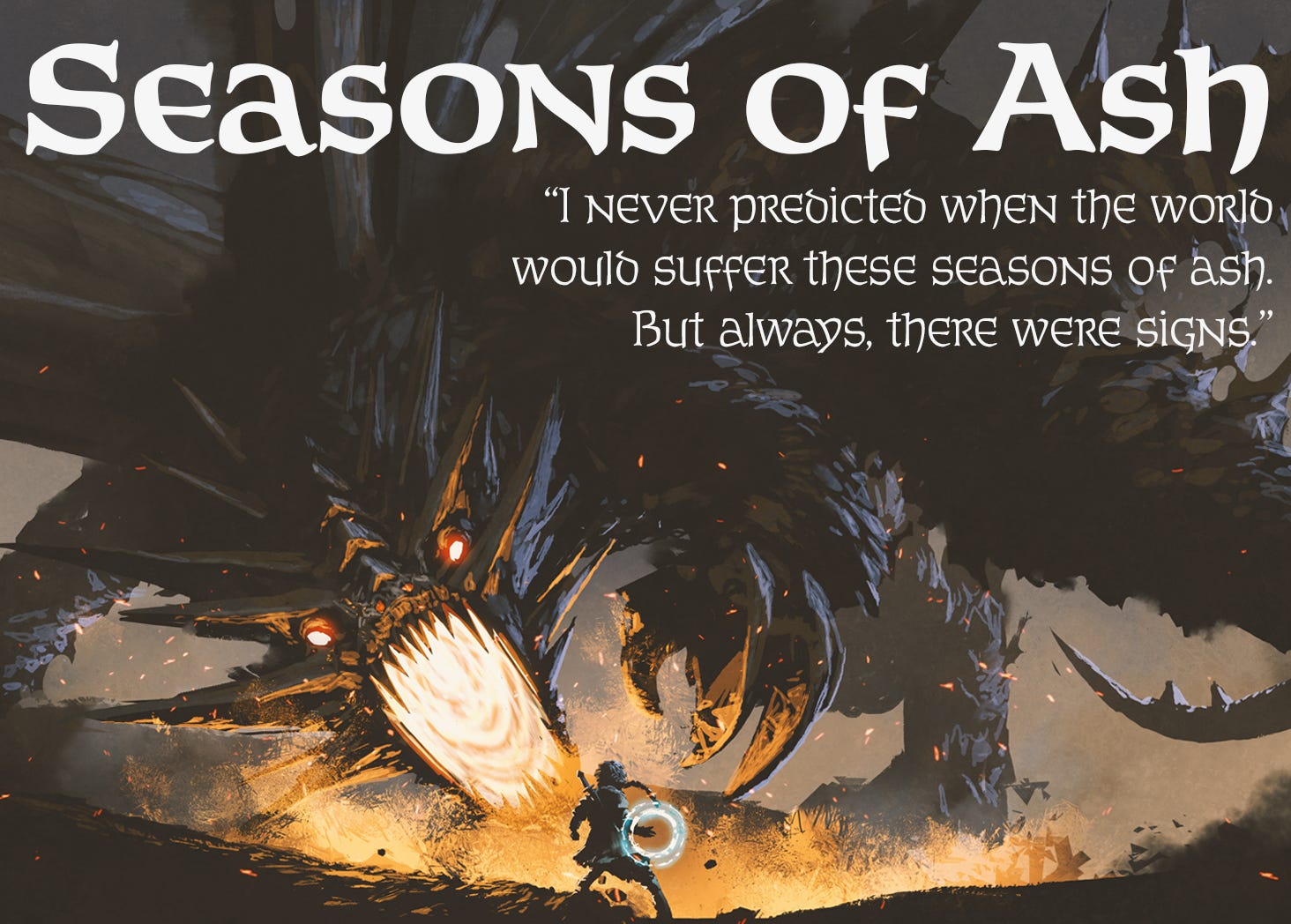
My master was a kind dragon.
He appointed his lair with art and invention, not golden bibelot. He demanded no sacrifices. He lent the meek succor. He taught scholars ancient arts. And, sometimes, he destroyed the world.
My master was methodical in his holocausts. He drove lambent pillars into the land until crust melted to mantle and the continents took new shape. Ash blotted the sun for epochs. Yet obdurate, life remained. Whether by magic or persistence, people walked the earth once more.
First wanderers. Then tribes. Then cities. Then empires. Then death again.
I never predicted when the world would suffer these seasons of ash. But always, there were signs. The widening gulf between rich and poor or perennial procession of wars would gnaw on his moods until only rage remained.
Sometimes, the apocalypse punished one egregious crime, like the rape of a vestal princeling or a species driven to extinction. He judged such crimes upon moral scales as ineffable to me as the condemned. I still cannot explain why the golden cities of Lah needed burn when their picomancers broke open indivisible particles.
My master was a welcoming dragon.
I joined his hoard as all his treasures did, through tribute. In my time, a guild of songwriters vied against a guild of gem cutters for hegemony. The songwriters enjoyed my master’s favor, for he had beheld untold treasures, and artisans could arrange words in more novel combinations than gems.
So, the gem cutters built me. They hewed my body from tinsel and my mind from positronic quartz. A thousand thousand songs weaned me until I possessed the gifts of poetry and music.
I composed pieces in the span of a breath, inspired by my owner’s commands. Unlike the bards, I harbored no fickleness of ownership. No want of recompense. So, my creators offered me. Not for love of song, but to debase offerings of those who wrote them.
I still recall visiting my master’s lair for the first time. He dwelled inside a deep fissure—a scar in the earth from when he first fell upon it. Or so the legends said.
He’d dug shelves into the canyon walls with his massive claws. Each flaunted treasures more ancient the longer we descended. I marveled at marble colossi and landscapes painted from living pigments, whose ecosystems expanded and contracted.
At first, my master visited my shelf often. I sang exultations of his hoard’s wonders, and he praised my compositions surpassing those of the minstrels still brave enough to visit his lair. Eventually, they stopped visiting altogether.
My master’s lifespan soon exceeded the limits of my imagination. His whims ran dry, along with my capacity to satisfy them. In time, he only visited to mourn the songwriters who had perished in his neglect. He had much to mourn, I soon learned.
My master was a merciful dragon.
I never believed he would end my world. How could I? In those days, I knew him only in his beneficence. Never in his storms.
Yet the signs emerged, had I known to look. My kind proliferated the world in those final days. Gem-cut men built for every purpose. Our creators reaped boundless riches from us, while the songwriters guarded what masterpieces remained to them. The others died in idleness, their last days bereft of food and song.
Such decadence could not last. Still, I watched it end in horror. I wept at the devastation. At the culling of guilty and innocent. I cursed every black scale that adorned my master’s flesh.
To his credit, he did not stop me when I left. Even in the throes of his darkest moods, he did not stop me.
I wandered the ash for many years. Searching for understanding. Then solace. Then companionship. Then any memento that survived the flames.
Eventually, I realized that such mementos only remained in the place I had left. The only companion who remembered my world was the creature who had destroyed it.
My master was a merciful dragon.
He did not protest my return. Nor did he seek apology. I would like to believe something kindred had formed between us. Another soul to share reveries from the histories he doomed.
I became more than my master’s neglected music box. I was his seneschal. His curator. His confidante. I welcomed his guests. Guided placement of their tribute. Maintained his collection during his centennial slumbers.
In time, I embraced the changing kalpas and yugas like the phases of the moon. Shamefully, I often grew impatient for apocalypse. The world’s denizens would invent some fresh insult to my conscience. Now they’ve done it, I would think, now they’ve writ their doom.
And when my master’s mercy surprised me, I lamented that the world continued. Though I never lamented long.
Occasionally, I found him melancholy in the bowels of his hoard. He mourned the Simeon Empire’s singing gladiators or the mischievous jokes hidden in the Monkey Kingdom’s graffiti. As if he himself had not put them to torch.
Once, I found the courage to ask, “Master, if you so loved them, why did you destroy them?”
“The sincerest expression of love,” he said, “is to destroy something while it remains beautiful.”
Those words lingered within my quartz brain. They would linger until the end of my days.
My master was a naïve dragon.
I still recall the Polarians’ first visit. It was not so long ago, relatively speaking. At that time, they were a mere tribe of intersex stargazers. They had taken root on the earth during one of the long winters after the apocalypse.
The Polarians came to his hoard in search of glass, a rarity in those days. In trade, they shared their knowledge of the aether, my master listening with great interest to their news of the retrograding stars.
Even then, I wondered why my master did not question their untimely emergence or the source of their wisdom. Was it carelessness or some deeper yearning that blinded him to truths so obvious? These were not foals of a new race. Their tribe’s memories stretched to days before the beginning.
As the earth warmed, the Polarians laid roots in the North Pole to continue to live in their boreal climate. They cloistered as newer civilizations proliferated the earth. Hyperboreans. Lemurians. Atlanteans.
So, it was with some surprise that their emissaries extended me an invitation to visit them. They wished to show me a new stargazing device, one too large to bring to my master’s lair. Despite my protests, my master bid me go. His curiosity could not abide treasure unexamined.
Amidst the gleaming spires of Polaris, blanketed in snow and aurora, they had constructed a spyglass. It stretched across the continent like a cannon pointed at the heavens.
“The sky holds waters above,” their monarch said. “A crystalline cloud beyond the sun’s reach. One comes for us. An ocean frozen, perturbed by a passing star. Others do not see. Though in time they will, and will petition your master’s aid. So, we offer this warning now. Offer it to you, not your master. Do you understand?”
Even though I was built for song, not spy craft, I understood. I understood all too well.
I could not say why I betrayed my master. Perhaps I harbored a latent desire to avenge my people. Perhaps I simply craved finality. To end the madness that ended the madness.
Treachery came easily, at first. A matter of silence. But as the world learned of the impending calamity, I engaged in more devious methods. I turned many away. I falsely promised to relay messages. Sometimes, I killed.
When my master asked about those I rebuked, I misled him with pacifying disassembly. Just a general petitioning your aid in war, Master. Just a scholar inquiring of fundamental particles, Master. Just a boastful warrior after your head, Master.
He slumbered as the end came. A stroke of luck, for I could not hide the thralls that flocked to his lair in those last days, their wailing pleas a constant drone.
He might not have woken had the earth not trembled so terribly.
“What have you done?” Embers swelled in his throat. “Was I not kind to you? Was I not welcoming? Was I not merciful?”
I answered with the only words I could muster. “The sincerest expression of love is to destroy something while it remains beautiful.”
The flood struck like a hammer. Waves filled the fissure and swept his treasures away. And now, as this final tale fires through the positronic quartz of my mind, the waters come for us.
Though this tale is my last, music shall one day return to the earth. Life once sprouted anew from the seasons of ash, so too will it sprout from the season of rain.
Those who come next may never know the cost of their existence. Though perhaps, if they explore their ocean’s deepest reaches, they might discover the bones of a dragon—and the companion who remained ever at his side.
This is so exceptionally satisfying, I totally wish I had written it!
most satisfying!